Healthy skin is beautiful skin—not because of makeup or filters, but because it’s balanced, hydrated, and functioning the way nature intended. If you’ve ever admired that effortless glow, what you’re seeing is radiant skin that reflects light uniformly, with even tone, minimal inflammation, and that plump, smooth texture that comes from true health.
Let’s Redefine Good Skin
Marketing loves to complicate skincare—convincing us we need 12 steps, the latest gadgets, and endless exfoliation to get perfect skin. But here’s the truth:
Healthy skin is consistent, not complicated!
It all starts with the basics:
- Cleanse – to remove impurities without stripping the skin.
- Moisturize – to support the skin barrier and lock in hydration.
- Protect – sunscreen is non-negotiable, every day, rain or shine.
When these three steps become part of your daily rhythm, you’ve already created a solid foundation. From there, you can build a routine that evolves with your needs. I call it the Step-Up System—a gradual way to layer in more advanced care without overwhelming your skin (or yourself).
The Step-Up System to Skincare
- Start with GOOD
Cleanse, exfoliate gently, apply a moisturizer to boost hydration and support your skin barrier. SPF - Move toward BETTER
Add an antioxidant serum (like vitamin C), and always finish with SPF. - Graduate to BEST
Once your routine feels effortless, introduce targeted serums (for concerns like hyperpigmentation, fine lines, or breakouts) and incorporate resurfacing treatments 1–2 times per week to encourage cell turnover.
Start Small. Stay Consistent. Scale Thoughtfully.
The magic is not in how many products you use—it’s in using the right ones regularly and giving your skin time to respond. Whether you’re just starting out or ready to fine-tune your regimen, always come back to the core truth:
Consistency is what creates change. Balance is what sustains it.
Why Skin Anatomy Matters
If we want to care for our skin properly, we need to understand its structure. Skin is your body’s largest organ and it’s beautifully complex. There are three primary layers working together to protect you and keep you glowing:
1. Hypodermis (Bottom Layer)
This fatty layer houses blood vessels, nerves, and lymphatics. It cushions internal organs and plays a big role in temperature regulation. Without it, our skin wouldn’t have the support system it needs to function—or even stay intact.
2. Dermis (Middle Layer)
Here you’ll find sweat glands, oil glands, hair follicles, collagen, and elastin—your skin’s built-in scaffolding. These structural proteins keep skin firm, bouncy, and resilient. Over time, collagen naturally decreases due to aging and environmental stressors, contributing to wrinkles and sagging. While we can’t stop collagen loss, we can slow it down with healthy habits, topical support, and nutrition.
3. Epidermis (Top Layer)
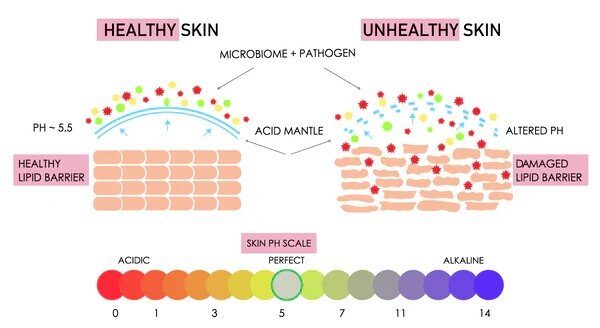
This is the layer we see and feel. It sheds and renews itself roughly every 28–30 days. The outermost part, the stratum corneum, is made up of dead skin cells forming a protective wall—think of it like bricks and mortar. The mortar is made of water, lipids like ceramides and fatty acids, which help retain moisture and protect from harmful invaders.
Atop this sits your acid mantle—a slightly acidic film formed by sweat and sebum (oil). This is your skin’s first line of defense against bacteria, viruses, and pollution.
The Skin Barrier: What It Is and Why It Matters
You’ve likely heard of the skin barrier, but what does that really mean? It’s not a singular place—it’s the entire system of the epidermis and dermis working in harmony to protect you.
When the barrier is disrupted—by over-exfoliation, harsh products, or environmental stress—everything falls out of balance. Moisture escapes. Irritation and dryness increase. Even immune responses can go haywire. A compromised barrier affects both your appearance and your overall health.
Moisturizing isn’t just cosmetic—it helps maintain this barrier, reduce infection risk, and prevent chronic inflammation.
Skin: More Than Just a Shield
Your skin is highly intelligent. It does more than just hold everything together.
- It communicates with your brain and gut when something’s wrong.
- It’s an endocrine organ, responsible for producing over 90% of your body’s vitamin D from sunlight.
- It contains over 1,000 sensory receptors per square inch—allowing us to feel, react, and regulate temperature.
In fact, when someone suffers a severe burn, it affects nearly every internal system. That’s how essential skin is to survival.
And—one of my favorite facts—skin is a tattletale. When nutrients are scarce, your body prioritizes critical organs first. Your skin and hair are often the first to show signs of imbalance, letting you know something deeper may be off.
Understanding Your Skin Type
Your skin type isn’t permanent—it evolves with your environment, lifestyle, hormones, and even the seasons. Here’s a simple test to get a baseline:
The Bare-Faced Test
- Wash your face with a gentle cleanser.
- Pat dry and apply nothing.
- Wait 30 minutes.
- Observe:
- Tight and Dry? You likely have dry skin
- Oily Overall? You’re probably oily
- Oily in the T-Zone only? Combination
- Neither Oily nor Tight? Balanced / normal
- Tingling or Redness after Cleansing? You may be sensitive
Remember: Skin types shift. You’re not locked into one forever. Climate, diet, hydration, stress, and hormones all play a role. Just like your wardrobe changes with the seasons, so should your skincare routine.
Consistency Is Everything
Results don’t come overnight. It can take 8–12 weeks to see visible changes when starting a new regimen. There’s no miracle product—only thoughtful combinations of ingredients working together over time.
Start by focusing on what your skin is telling you. Track patterns. Introduce products gradually. And when you find something that works? Stick with it.
Treat Your Skin Like a Scientist
Your skin is unique. So treat it like a case study. Don’t overload it with everything at once—especially if you’re trying to solve a problem. Observe, assess, adjust. Simplicity can be incredibly powerful when it’s strategic.
Final Thoughts
Healthy skin isn’t just about beauty—it’s a reflection of your overall wellbeing. The skin protects, communicates, regulates, and senses. When we treat it with intention and balance—not extremes—it rewards us with radiance.
Stay curious. Stay consistent. And don’t forget: healthy skin starts here.
Elevate Your Skin Routine
Smart care is intentional care. Results come from consistent, tailored strategies—not guesswork.
At Skin Fit Rox in Edmonds, WA, I provide advanced skin services and corrective skincare for age management, skin support, and acne solutions—in person or virtually, wherever you are.
Book your personalized consultation today and begin your Skin Fit Rox journey.
Invest In Your Skin Wisely.
👉 Book a consultation and let’s create your personalized plan.
P.S. Real results require real strategy. If you’re ready to invest in your skin health, I’m here to guide you.
Stay connected: For ongoing guidance and exclusive insights, follow @Skin.Fit.Rox or join our newsletter.